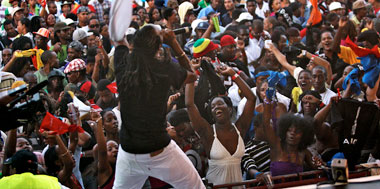
KONPA MUSIC COULD BE THE IMPETUS FOR AN ECONOMIC RENAISSANCE IN HAITI

All these large scale Konpa events -Konpa on Broadway, LNDJ, Konpafest, etc… with potential economic development -need to take place at home, in Haiti. Our Haitian economy is in a desperate need for a money transfusion to keep it alive.

If the promoters of these events refuse to make the transition, which will inject into the economy all these dollars being spent, we need to boycott them by holding in Haiti a similar event on the same day -in front of each and every single one of them.

I do believe that now is the time for us do start selling a new image of Haiti to the world; it is our responsibility, not that of the foreigners, to make it Happen. So if it is about large scale Konpa events or Haitian cultural manifestations, it should take place at home -unless it is about benefiting some people’s selfish personal gains.

I don’t see the American Music Award, BET Music Award, the Oscars, Spring Break, etc… being held on foreign lands. I don’t see all the big-time Reggae events being held outside Jamaica. It is because these people have always tried to keep the money in their economies by any means necessary, which is the way to go. Why can’t we do the same thing?

You have something called Konpafest, which is held in Miami every year around our Flag Day, on May18, where Haitians all over the world fly to Miami to show their solidarity and spend money. Imagine if we could channel all these people -Haitians and foreigners with money in their hands to spend -to come home every year to spend in our economy. It would be the start of an economic renaissance or rebirth for the Haitian people.

I know what the excuses are going to be to justify the ridiculousness of holding these events abroad, away from home.

Excuse #1: You are going to argue that Haiti does not have the logistics (hotel rooms, restaurants, transportation, electricity, etc…) to cater to the needs of the people that will be traveling over there for the events. Nonsense!!! There may not be the need to invest in more upscale restaurants and hotels now because the demand is not there. And the demand is not going to create itself; we the people of Haiti must generate it.

Business people are opportunists, meaning wherever there is a potential demand, you can expect to see heavy investments being poured into that sector of the economy.  Why the demand is not there? The demand is not there because we refuse to create it. We rather keep our butts abroad awaiting the foreigners to come do it for us while the country is dying of a severe economic anemia.

Excuse #2: The insecurity makes it impossible to encourage people to travel to Haiti. Here is another nonsensical argument. I am not trying to dismiss the insecurity plague. It would be very dishonest on my part to argue that it is not an issue. However, in terms of crime/murder per capita, according to the nationmaster.com, Haiti is safer than Jamaica, a country with a booming tourism industry. Yet, that is not preventing the foreigners, you Haitians included, from traveling over there to spend money.

Most of the crimes committed in Haiti are what I would call “necessity crimes,” crimes perpetuated by people because they want to survive or feed their families. That’s basic human behavior when it comes to securing one’s survival. And, for the most part, they take place in Port-au-Prince, the capital city. But if money was being poured into the economy, more jobs would be created for them to make a living, meaning less of these crimes would occur.

The international media has done a tremendous job destroying our image abroad. But it is all our responsibility to prove them wrong by showing and selling a different Haiti, which must start with OUR efforts and involvement.

In conclusion, my advocacy is not to destroy or endanger anybody’s business; it is, rather, a way for us to start caring for ourselves again as we used to in the 1960’s and 70’s, which is the only way we can challenge the destructive campaign being waged against us by the international media.

They can tell us all the lies in the book about our home, but it is our choice to believe in them or not. Our home is our home. The way we care for it is exactly what is going to get the foreigners to come visit us in there. And when they do come, they come with goodies and gifts in their hands for us.

Let us stop all the baseless justifications for not investing into our economy. These big-time cultural events being held in the Diaspora are somewhat hurting the economy back home, because they are not being held there to help the economy moving forward. If we are willing to travel from all over the world to the US to attend some Konpa event, we can do the same if it is happening at home, in Haiti.

Source:

http://www.nationmaster.com/graph/cri_mur_percap-crime-murders-per-capita

A LITTLE SOMETHNG FOR MY HAITIAN PROMOTERS

As Haitian migrants living in America, English is NOT our language. We are only using our audacity to speak it as though it is ours; we are not doing too bad to adapt thus far.

I have a big complex, and I do believe others do as well. I am not too demanding, but I demand some degree of standard. If you are in the promotion business trying to convince me to buy whatever it is you are selling, if you cannot write, hire someone who can to handle the promotion literatures for you.

My complex is this: if upon opening the promotion literature to read about whatever it is you are promoting, I realize that you cannot even write to express yourself clearly (from the very first word to the very last, you make typographic or intentional mistakes), I move on; I don’t even finish reading. I cannot take you seriously, regardless how great of a product or service it is. So you just lost one prospective client/buyer/consumer.

Marketing, which promotion is a pillar of, is all about playing in the psychology of the buyer. So as a seller or promoter, you must do the best you can to inspire trust and confidence in the buyer. The buyer will not just trust or believe your word that this service or good you want him or her to buy is not a fraud just because you say it is not. So if through your promotion literatures you cannot inspire that level of trust and confidence, you will soon be out of the door. In other words, you will not get far.

The only remedy to that is to acknowledge the fact that you need help in that department and bring on board someone who masters the writing aspect of the business to help you out. Don’t assume that you can do everything on your own. It is okay to have limitations. We all have limitations. There is nothing wrong with that. That’s why you need a highly qualified and up-to-speed staff to help you to achieve the level of success you are aiming at. It is all about making a positive impression. If you can do that, assuming that your service or product is up to or beyond par, you will get far.

ALL successful business entrepreneurs surround themselves with a team of experts to help them bring a vision to completion, why not you? Well, then again, not all entrepreneurs are in business to be successful, though that to me is a little odd.

Well, I hope you promoters and sellers out there get the point I am making and are not trying to resist. You don’t have to listen to me; I am a nobody. BUT if you are smart enough, and I want to believe that you are, you will stop being judgmental and listen to the logic embedded in these words. I am a nobody who just wants to help; hopefully, you will find these words of advice helpful.

Oh, by the way, since someone on Facebook, who could very well be reading this and find it helfpful as well, allegedly called me a plagiarizer, I want to earn your trust by telling you that I did not plagiarize this opinion online. It is MINE; so you are given the green light to make it your own.  😀

PRESIDENT OBAMA’S TAX DEAL IS NOT TOO BAD

On the tax deal the president cut with the Republicans, I think at first, until I took my time to really read on and understand what is in it, I was a little too harsh on the White House. Being the pragmatist that I am, when I look at all the variables in the political and economic calculi, I can sense the rationale behind such deal.

In reality, it is not too bad of a compromise. The political dynamics in the House of Representatives and the Senate basically dictated the nature of the deal. It is not a perfect deal, but the provisions in it will help boost the economy in the short run.

What did the president and the Republicans want initially? Initially, the president wanted to give tax cuts to those Americans making less than $250,000. The Republicans, on the other hand, wanted to extend the Bush tax cuts for the wealthy. So the question was how to bring the two extremes to meet right in the center? To do that, both sides had to compromise. And that is exactly what they did. The republicans got the Bush tax cuts for the top 2% Americans extended only for two years; the president came out with a major economic stimulus package. What did the president get out of the deal? He got a package loaded with economic goodies. He got:

  1. Unemployment insurance extension –There is no way he could have gotten the extension to pass if he did not compromise; the republicans were not going to budge. Right now, millions of Americans are out of work. They lost their jobs to no fault of their own. The unemployment benefit is their only source of income. So he had unemployment insurance extended for 13 months for these people, which would have not happened otherwise.
  2. Earned Income Tax Credit (EITC) –This is a tax provision given to the low income working Americans having dependents and struggling to make ends meet.  
  3. American Opportunity Tax Credit (AOTC) –This tax provision gives up to $2500 to those Americans having a child in college. It may not sound a lot, but this is money that can be used in many ways for someone’s education.
  4. Child Tax Credit –This is a tax credit given to families depending on the number of dependents they have. This provision comes with a significant cut in the payroll tax that all workers pay, which will save them over a thousand dollars a year.
  5. Investment incentives –This provision gives tax break to companies that are willing to create jobs here in America by building companies and investing in equipment.

This is real money given back to real people to spend in the economy. And when money is being spent in the economy, it tends to get the economic growth rate up.

President Obama had to extend the Bush tax cut for 2 years (not permanently as the Republicans initially wanted) for the top 2% wealthy Americans to get these aforementioned provisions to pass the gridlock in Congress. If he did not make that compromise, come January the 1st, taxes would have gone up to thousands of dollars on the middle class, which would have been disastrous for the already struggling economy. So he had to do something. This is a situation where you are not looking for the infant to look like his/her dad; you just want a safe delivery. And that is exactly what he did.

The White House, as always, has a communication problem. The fact that they are not communicating effectively what is in the bill for the middle class, the people now turn to the political pundits and talk show hosts to have the bill explained to them. And quite often, these people do not seem to be telling the whole truth.  

So the president extended the Bush tax cuts for only two years to get most of what he wanted. Come election time in 2012, he will then have to fight to let them expired. I only hope at that time he will have the political leverage to do so.

I DISAGREE WITH MARTELLY’S SOCIALIST VIEWS

I am glad I spent time to carefully listen to this clip of Mr. Martelly. At the very end of it, he unveils his plan to reform our agricultural practices or means of production. His plan is pure socialistic, which we don’t need for Haiti.

I am for the state to subvention or give incentives to the farmers to help them to cultivate the lands -just like we do here in the United States. I wholeheartedly disagree with him, however, when he wants the state to run agro-credit institutions to lend the farmers money to cultivate their lands. We don’t need that. Keep the state out of the credit market. Let the private sector compete for better rates to the farmers. When it is like that, you create a competitive marketplace where the farmers can go around and shop for the institution that could give them the best deal.  

I also disagree with him in that he wants the state to buy the farmers’ harvests from them in an attempt to control prices on the national market. So if he does that, how could he expect the farmers to compete for better quality products and better prices for those products then? You cannot have players competing against each other in the sector of government. Basically he wants to do (to us) the same thing we allowed the American farmers to do to us. I say let the competition in the market dictate how prices should be fixed and controlled. In other words, let the market control itself. We don’t need the state to be like a godfather controlling the market.

Also, he talks about creating jobs in the peasantry sector, which I disagree with. Government is not in the business of creating jobs. The job of government is, rather, to enact economic policies that would encourage job creation by the private sector.  

As I said many times before, in Haiti, the biggest competitor is the state, causing a problem for the private sector to compete for greater performance and returns on their investments. The market tends to be stalled when the state gets to compete against the private sector. If anything, we need to encourage a competitive market environment, not discouraging it. That’s what capitalism teaches us. We don’t need a socialist economy in the likes of Mr. Martelly’s proposal. It is not good for business, and certainly not good for the economy.

Haitian Business and Poor Customer Service: Synonymous?

By VAYOLA PROPHETE

Published: November 09, 2010

Before I get to the crux of this piece, please understand I love my Haitians despite their flaws and imperfections. That’s part of what gives us our distinct character. This piece is being written to shed light on a chronic and pervasive issue in the Haitian business community. To be quite honest, this piece could extend to also incorporate the entire Black community, but I’ll focus on our people for now.

I’m a chronic bootlegger. If I can download it for free, I will. Hey, there’s no shame in my game. Times are hard. The avenue with which to download anything I am looking for is easily accessible and super convenient. For some reason, though, I decided to support the Haitian music industry (HMI) by purchasing a few Haitian CDs. I took it a step further and decided to order from a Haitian website: everythinghaitian.com (EVH). I’ve been on the site before. I’ve even made purchases before. I had an issue in the past, but it was resolved; I thought nothing of it. I figured I’d give EVH another chance. I mean they are Haitian, so why not, right?

So I made my purchase back on September 20, 2010. I spent a little less than $45 on this site, which was debited from my account the very next day. I received two receipts immediately. That was new! I was excited that from the last time I made a purchase, a few things had changed for the better. I figured by the end of September -early October the latest- I’d be blasting my Kompa. Boy was I wrong!

Today is November 9, 2010 and I still haven’t received my CDs. Attempts made at contacting someone from the company has been met with silence. The only form of contact available is e-mail, which is also new. At least I had a phone number to call to speak to an actual person last time. I’m fairly certain that e-mail account was set up to avoid having to speak to customers. Better yet, is anyone actually monitoring it?

I’ll give another example. When I’m feeling too lazy to cook, I’d order from a Haitian restaurant. When you call in, you’re greeted with attitude from whoever is on the other end of the line. The specials are never listed over the phone; the wait for the food is exorbitantly long, and a simple “Thank you! Please come again!” is never uttered. God forbid you go to the restaurant to eat. It’s very likely you’ll leave before being served. Between the inefficiency in the kitchen, rude waiters/waitresses, and the total disregard of your presence in the establishment, most people will leave with their money in tow!

Basic customer service skills are necessary to sustain any business, especially when contact with the consumer will be made regularly. A greeting, a smile, and a genuine effort to be of service go a long way in assuring the customer that their hard-earned dollars are appreciated. Which begs the question, why then is it so hard for Haitian businesses to adapt to such a customer service model? Don’t get me wrong. Not every single Haitian business out there has poor customer service, but it seems as though there’s a majority that do and that’s a HUGE issue if they are to be financially viable in this economy.

So here’s my overarching question: how do I support a business that obviously doesn’t value me as a customer? I can answer it: I DON’T!!! I take my business (and MONEY!!!) elsewhere. If enough customers follow my lead, there won’t be any Haitian businesses left standing. That would be a shame, indeed!

A quick word of advice to current and future Haitian business owners: if you want customers, you have to learn to appreciate them while servicing their needs to the best of your ability. Learn what it means to provide superior customer service and make that a practicing standard in your business. Relying on Haitian camaraderie to get by is simply not going to cut it! Haitian or not, my money goes to the person(s) that is/are trying to make me happy as I spend it. If you happen to be Haitian, awesome! If not, your loss. Get yourselves together and I guarantee your returns on investment and profit margins will increase exponentially!

Thanks for reading!

WE NEED TO ELIMINATE PUBLIC EDUCATION IN HAITI

This is a public policy matter, and I do expect many to disagree with me. Public education in Haiti needs a total reshuffling; it must be incorporated in a comprehensive plan to reform our economy. We cannot be talking about reforming the economy if we do not address the problems with our education.

We need a new system of education to prepare our kids to compete for the jobs of tomorrow at home and abroad.

Public education is a total failure in Haiti, and things will not get better if we do not change course. We need to take government out of the business of educating our kids and let the private sector take over.

Is Haiti a socialist or a capitalist state? Maybe we need to be clear on the type of economic system we have and the type we really need for Haiti. I am a big proponent of capitalism, for it does make sense to me. Maybe that’s what we need for Haiti. Right now, whether you want to agree with me or not, we have a socialist state; government controls almost everything.  

Before we get further in this, let’s take a moment to explain what the job of government should be in a capitalistic economy.

The role of government in a capitalistic economy is NOT to create jobs and compete against the private sector. It is, rather, to enact policies that would encourage private sector jobs. It should work to strengthen the private sector, and the two must work hand in hand to get things to work for the betterment of our society. So needless to say, we need a strong private sector.

In Haiti, government is the biggest competitor we have in the market, preventing the economy from expanding because it stalls competition. It should not be this way. Government is not to compete against the private sector. It is to set the path for the private sector to walk on.
 
I propose the elimination of all the public schools or state-funded institutions of learning and let the private sector take over them. As we have them right now, they are ineffective and represent a symbol of failure because of a lack of competition within the sector of government. We need to get rid of that.

Government should not be in the business of opening schools. It needs to allow the economically disfavored students to attend private schools or the school of their choosing by making grants and scholarships available to them. Doing so will create a market of schools for them to choose from. Giving them the ability to choose the school of their liking will empower them, and that will fuel the competition needed to get the system to work.

If competition is the engine that gets the economy to move, choice is the ignition that gets it to crank up. When government gets in the game, competition is stalled; the economy automatically stops expanding. On the other hand, when you have the players in the private sector competing against one another, it is good for competition in that it results in quality production or quality education for the students. In such a competitive climate, only the best schools will stand. The subpar or mediocre ones will have to close their doors because they won’t be able to sustain the competitive wave. That’s the phenomenon of the “invisible hand” Adam Smith, the Father of Capitalism, talked about in his masterpiece entitled An Inquiry into the Nature and Causes of the Wealth of Nations.    

In conclusion, we need to revamp the system of education in Haiti by allowing the private sector to assume its total control. The government should not be in the business of opening and managing schools. It should be there to subvention the economically disadvantaged students by providing them with grants and scholarships to attend the school of their choosing. Such a strategy will automatically fuel competition within the system, which, in turn, will produce the best educated kids to contribute in the economic and social development of their society.

SOCIO-ECONOMICS: A COMMUNITY OUTLOOK FACTOR

If you drive through any suburb of New Jersey, you could barely see a liquor store, a fast food restaurant or a church on your way. Yet, in the economically disfavored cities (i.e., East Orange, Orange, Irvington, Newark, etc…), all you see on every block are liquor stores, fast food restaurants (McDonald, Burger King, Wendy’s, Checkers, Popeyes, Chinese, etc…) and churches. And I truly believe it is like that in most, if not all, of the cities across the country. Trust me, there is a reason for that.

When in nursing school I was studying Community Health Nursing at the University of Medicine and Dentistry of New Jersey, I was extremely disturbed by this observation. As part of our final grade, we were to team up with a partner to work on a community health research. My partner and I were assigned to conduct a windshield survey in the city of East Orange to depict the socio-economic realities the citizens in that city were facing and how they (those realities) were impacting lives.

Windshield surveys are a form of information gathering mechanism, involving making direct visual observations of a neighborhood or community while driving. These types of surveys are quite an inexpensive, time-efficient approach to assess the social environment of a community. They can even be conducted on foot in the event that a vehicle is not available or practicable.

The purpose of the windshield survey my partner and I conducted was to gain a better understanding of the city of East Orange’s social environment in terms of its boundaries, housing conditions, use of open spaces, shopping areas, schools, religious facilities, human services (such as hospitals and physician offices), modes of transportation, protective services (such as fire and police stations), and the overall neighborhood life.

We were working closely with the health officials at the East Orange Public Health Department to retrieve and analyze health-related policies, prevalent diseases and statistical data. It was a very insightful research study, which was worth conducted.

Many may be asking why you only find the McDonalds, the Burger Kings, etc… in these economically challenged neighborhoods. Well, first of all, you cannot blame the city officials; they do not have control over that. It is pure economics –supply and demand. Why supplying a good or service to a population that does not have the financial or purchasing leverage to afford it? In other words, what is the sense for a fancy restaurant owner selling healthy food to come open a branch in a neighborhood where the people cannot afford to buy the exquisite meals? That would be really stupid, especially when we all know that business people are in business not for sympathy but for the purpose of making money.

What explanation do I have for the presence of the liquor stores and the churches in those neighborhoods? It is so because there is a demand for them. Otherwise, they would have not been there. Most of the people that live in poverty cling to their drugs to help them forget about the stressful lives they are living and their religion to give them a sense of hope. Do the people in the suburbs consume alcohol and honor their religion? Yes, they do, but demand is everything.

Could the city officials implement policies to discourage these businesses from opening shop in their neighborhoods? Well, that would be economically stupid on their parts, especially when we know the level of education of their constituents only equip them for these kinds of jobs. If they (these jobs) were to be pushed away, then what would happen to employment opportunities and tax revenues which the city governments desperately need to run their operations? So it is a vicious circle, which can only be broken and reversed (on a long-term basis) through a drastic agenda of social reforms with emphasis on investing in the people’s education to increase their socio-economic worth.

DEFORESTATION WON’T STOP KILLING HAITIANS


Aerial photo taken from above the border


Definition


Deforestation refers to the total logging and/or burning of forest space -whether this destruction is due to cattle ranching, plantation agriculture or real estate development. It is also the permanent conversion of forest cover to non-forest purposes. There is a big difference between deforestation and forest degradation. While forest degradation may change the ecology of certain forest aspects, it does not, however, destroy all forest cover, which is what deforestation does. So deforestation is much more serious than forest degradation.

Historical aspect of the Haitian deforestation

The majority of us Haitians are descendants of slaves brought from Africa in the 1600s by French colonizers, who then destroyed tens of thousands of acres of forest for the purpose of cultivating the sugar cane that placed Haiti in the lead of the world’s sugar producers. Hence, more forests were destroyed to fuel the sugar mills and be shipped to Europe to make furniture of mahogany and dyes or colorant from campeachy.

After the revolt of the slaves that culminated in the defeat of the Napoleon Army and gave birth to the nation of Haiti, the world’s first Black republic in 1804, great plantations were partitioned among the slaves. Under the inheritance law that governed the then French society, land is distributed among a man’s heirs. A demographic explosion of the Haitian society was going to compromise the applicability of that inheritance law. “One of the fastest growing populations in the world — Haitian women average five births each — has reduced the average holding to little more than a half acre. That is not enough to support a family of seven even in a good rainy season” (Braken, 2004).

The economics of deforestation in Haiti

Because the land could no longer satisfy the farmers’ daily obligations, they found themselves under intense economic pressures for income -simply to take care of their family. So unbearable such a reality has become for them, they had to chop trees to make and sell charcoal.

In a report filed in September 23, 2004 by Amy Braken of the Associated Press, who quoted Mr. Victor, an agronomist, the deforestation in Haiti has moved from bad to worse. According to that same report, from 1950 to 2004, the 25 percent of Haiti’s 10,700 square miles that was covered with forest has reduced to only 1.4 percent.

According to David Adams, a former USAID director in Haiti, over the past 20 years, the U.S. Agency for International Development has planted 60 million trees in Haiti, but the poor chop down 10 million to 20 million trees each year.

Consequences

The rapid destruction of forest cover has serious economic, ecological and ethical consequences on the lives of the Haitian people. Millions of people in Haiti as well as other poor countries around the globe face permanent poverty as a result of the deforestation reality. In a case study titled Deforestation in Haiti, such a devastating reality got Kristen Picariello to say, “If one were to fly over the border between Haiti and the Dominican Republic, the border appears like it was drawn by an ‘acetylene torch’ owing to massive deforestation in Haiti.”

We cannot address the deforestation reality in Haiti without placing under the microscope the most recent tragedy of hurricane Janne. Dan Bjarnason, in an article entitled Deforestation in Haiti published in the CBC News Online of October 01, 2004, stated that Janne had a big toll on Haiti because the country’s natural defenses were extinct. He went further to say that Janne was yet to become “a full-blown hurricane when it hit Haiti. At that point, it was only a tropical storm. Still its impact was enormous.”

Comparing Haiti to its next door neighbor, the Dominican Republic, one can see a heartbreaking reality. The Dominican Republic is lush, green, and fertile. On the same island, neighboring Haiti is mostly mountainous and virtually denuded of trees. That’s the troubling difference that exists between the ecological profile of the two countries sharing the same island.

Haiti’s forests then were destroyed to fuel colonial sugar mills; now its people, impoverished by a thread of gangster governments, are left with no other alternative but to destroy what is left of their trees just to survive.

“There are simply no jobs in Haiti, and for many people, cutting down and selling trees is a form of income, which they would otherwise not have,” says Daniel Erikson of Inter-American Dialogue. “Then the other side of it is 70 to 80 percent of the Haitian people have no access to modern electricity, so they need wood-based charcoal to cook, to provide fuel for heat, for light.”

One does not need a Ph.D in environmental economics to understand the reason why tropical storms are a calamity in Haiti. Ken MacDonald of the University of Toronto did a tremendous job at explaining the situation in very basic terms. He said that when there are no trees to break and absorb the fall of raindrops in a storm, they (those raindrops) crushed into the ground like bullets.  Because the soil is not strong enough to sustain and absorb the water, not having any place to escape to, it accumulates over land in a very short period of time -a situation that gets even worse because of the slope that covers most of Haiti.

The politics behind the issue

After the floods of May of 2004 that killed hundreds of people and left thousands without a home, interim Prime Minister Gerard Latortue said, “The root of the problem is that we have to go and reforest the hills and until we do that, every two, three, four years after some heavy rain, the same thing could happen again.” That is very true, but what did he do to solve the problem? Absolutely nothing!!! The problem with our politicians is that they are good talkers, not so good actors. What he said in 2004, we knew it then and still do today. He said we have to go on and reforest the hills, how is it going to get done? As the person in charge of the country then, that’s what he should have been talking about, not telling us something we already know.

It is not that we don’t have environmental laws to remedy to that chaotic reality of deforestation that the country is living at this present moment. According to that same gentleman Erickson quoted earlier, “Haiti actually has some environmental laws that are quite reasonable and quite good, but there’s absolutely no enforcement, and in most of the country, you have no functioning state whatsoever.”

Projecting toward the future

The future looks very gloomy for us in our battle against deforestation. It has been forecast that as the population mushrooms or swells in the next 20 years, twice as many people will be going after the fewer trees we have left. And Jean-Andre Victor, one of Haiti’s top ecologists, predicted that if nothing is done to take care of the deforestation problem, the situation will continue to deteriorate and other catastrophes are foreseeable. So inaction on the part of the government is not warranted; it is not going to efface the problem. If nothing gets done with a sense of urgency, the situation will get worse and more people’s lives will be exposed to greater and unthinkable natural calamities.

We need a comprehensive reforestation strategy which will take into consideration our geographical location, the people’s socioeconomic reality, the available and alternative sources of energy, the psycho-sociological aspect of the issue and all that. So this is a very complex issue whose scope must not be underestimated.

A comprehensive reforestation strategy will not come to light by spontaneous generation. We do need good and proactive leadership which only active and responsible politics can foster. That’s why it is imperative that we stop falling for political talkers. It is time to put in office political actors with a clear understanding of the people’s problems and a clear vision for the future to lead the country.

Any development plan for Haiti must incorporate the country’s ecological health. There can never be social and economic developments if this issue of deforestation is not properly addressed. This issue is so crucial that it is a make or break issue for any prospective development plan for Haiti. So, yes, deforestation is Haiti’s number one serial killer.

http://www.american.edu/TED/ice/haitidef.htm

http://www.waterconserve.info/shared/reader/welcome.aspx?Linkid=35159

Source: Copyright 2004, Associated Press

Date: September 23, 2004

Byline: AMY BRACKEN, Associated Press Writer

INDEPTH: HAITI

Deforestation in Haiti

CBC News Online | October 1, 2004

Reporter: Dan Bjarnason

ROLE OF GOVERNMENT IN A FREE MARKET ECONOMY

Some, if not most, in our society are very confused when it comes to the role government must assume in a free market economy. There is a reason why it is called “free market economy.” It is called so because government must not dictate the course the economy should take. When you have government controlling and/or interfering in the course the economy should or must take, then we have an economy that ceases to be free.

The role of government in this type of economy is to guarantee the fluidity and complete functioning of the world of business. That is so easy to say. But how can government make that possible? That’s where the bulk of the challenge lies.

Government makes possible the fluidity and functioning of the business world by enacting and implementing laws/policies that could guarantee the rights of the individuals to own properties and have these rights secured and respected. Also, government must strengthen the institutions that could guarantee the security of the physical aspect of all private investments in a stable political climate.

There is no doubt that government alone cannot make an economy work for the betterment of all its citizens. It does need to partner with a progressive private sector (watch the emphasis put on the word progressive) to make that happen.

Government must not position itself as the ultimate competitor, which, sadly, is and has long been the case in Haiti, our beloved country. When you have government -whose primary job is to guarantee a safe environment suitable for business -competing against the private sector, the market tends to become unfair, which in itself is a detriment to economic development and progress.

It is imperative that government guarantee a secure and politically stable playing field where all the players in the economy can play freely within the realm of fairness and dignity.

What we need to keep in mind is that business people are like migratory birds. They would build their nets and lay their heads wherever they can find their peace of mind to operate, without having to be reminded of the possibility of their investments being ransacked. So when you have a volatile political climate -where any unexpected thing can happen at any given time, which may put in jeopardy the security and good operation of private investments -then you have a situation that cannot synchronize itself with the expectations of the private investors. What will happen next? That’s when you start seeing private investors leaving the economy for places where the security of their investments can be guaranteed, creating an anemic economy.

We need to do more to attract private investments from foreigners and Haitian natives living in the country and in the Diaspora. Money is just as important to the economy as blood is to the human body. No economy can survive without money circulating in it.

I’ve said this before and I am going to say it again –this time I am going to say it louder so it can finally register in the carcass of your heads. THE ERA OF “DECHOUKAJ,” “KRAZE BRIZE,” KIDNAPPING, INTOLERANCE AND LAWLESSNESS MUST BE OVER!!!!! These practices have not produced positive results for the country as a whole and the economy in particular. We have been doing “dechoukaj” and “kraze brize” since 1804, the year our nation was officially created, what have we gained? I can tell you that we have not benefited anything positive. Instead, we are progressing backward.

So, what is the job of government in a free market economy? It is to make sure that the democratic and institutional structures are in place and strong to guarantee a stable political environment and a strong economy. That’s when we’ll start seeing investments coming in, and we will be able to keep the ones that are already in the economy. Needless to say that security and political stability are paramount.